

Grammar Guide: How to use Double Comparatives | On Your Mark's English
- Mark Connolly

- Jan 4
- 2 min read
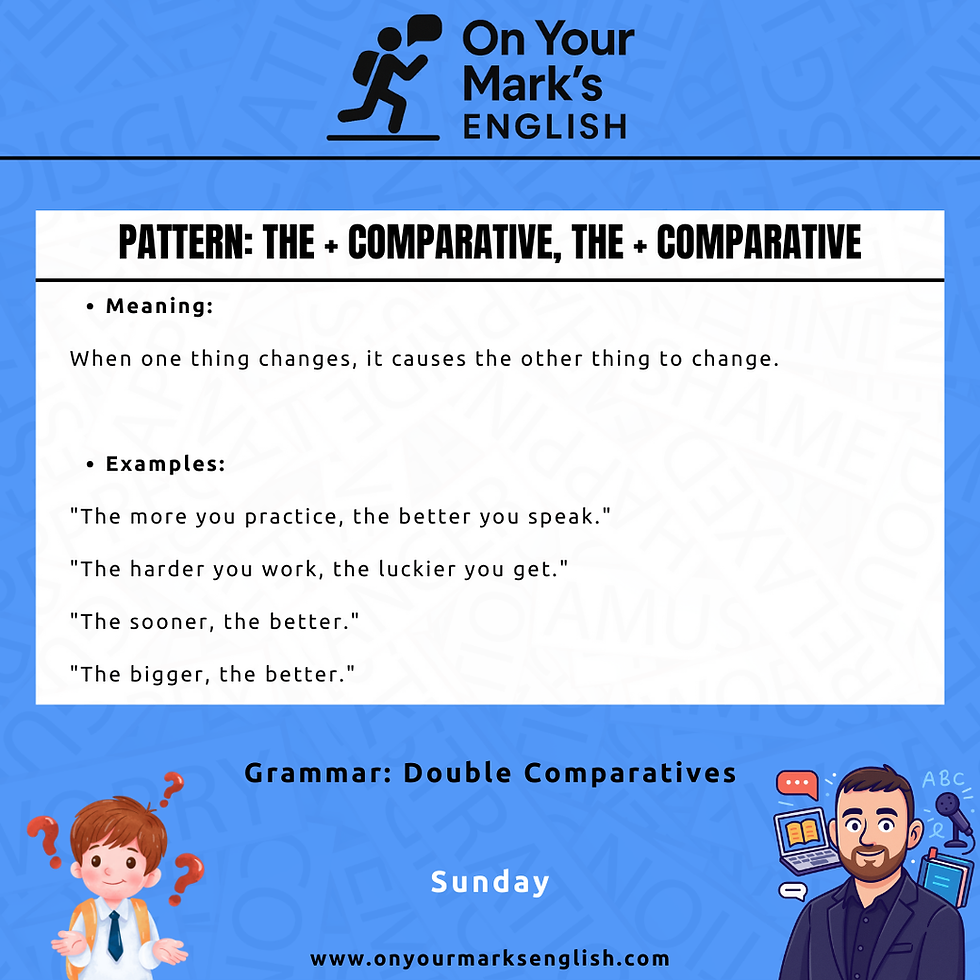
Cause and Effect in English
Usually, we use the word "If" to show a result.
"If you study more, you will get better."
But there is a more advanced, stylish way to say this.
It is called the Double Comparative.
The Formula 📐
The + [Comparative Adjective], The + [Comparative Adjective]
Remember: A "Comparative" is a word like Bigger, Smaller, More, Less, Better, Worse.
How it works
The first half of the sentence is the Cause.
The second half is the Effect.
Real Life Examples
For Learning: "The more you read, the more vocabulary you will learn."
For Age: "The older we get, the wiser we become."
Short Phrases (Idioms): Sometimes we don't use a full verb.
"The sooner, the better." (Please do it as soon as possible).
"The more, the merrier." (If more people come to the party, it will be more fun).
Your Turn
Complete this sentence about your own life: "The more I ______, the ______ I feel." (Example: The more I sleep, the better I feel).
Write your answer in the comments down below.
🎯 Want to Improve Faster?
If you enjoy these lessons and want to improve your English more quickly, you can book 1-to-1 lessons with me through my website.
Every class is personalised to your level and goals, and I’ll help you build confidence in speaking, writing, and grammar step by step.
👉 Visit www.onyourmarksenglish.com to book a lesson.


Comments