

English Question Word Order Rules: Common Grammar Mistakes
- Mark Connolly

- Mar 19
- 2 min read
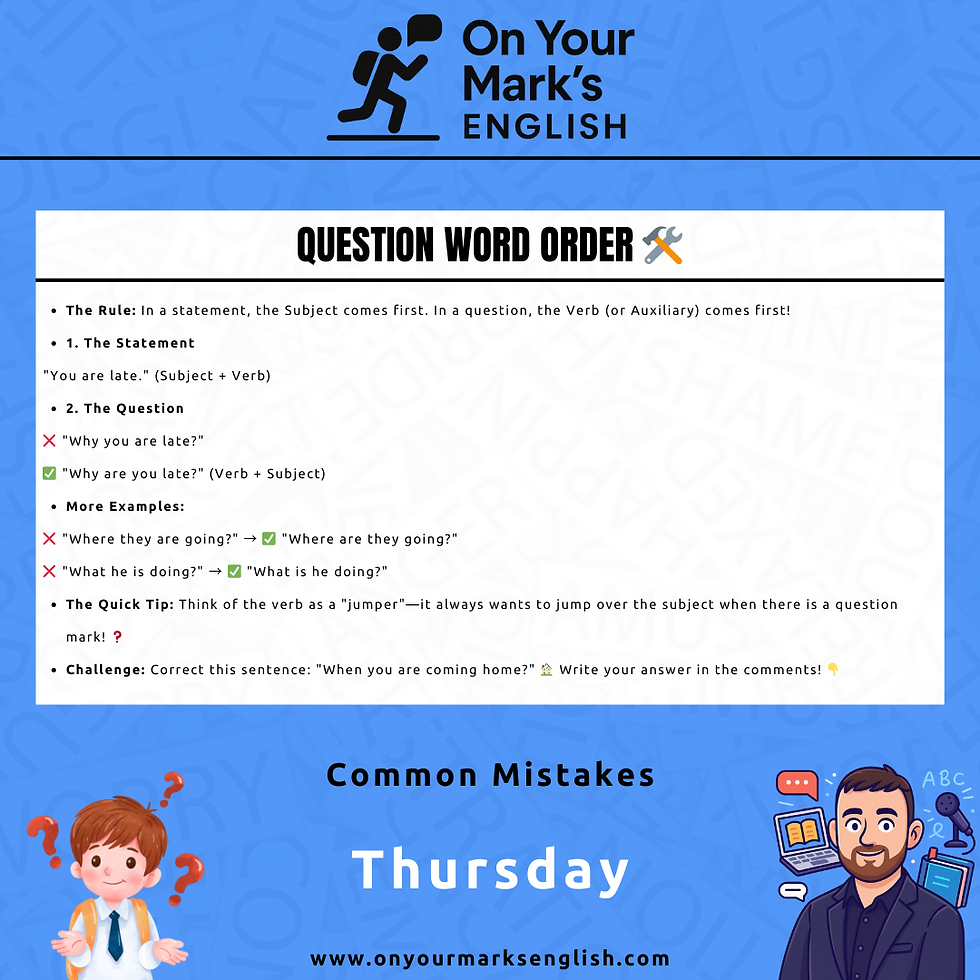
Thursday Common Mistakes: The "Subject-Verb Swap" Secret
🎥 Watch the video version of this lesson above!
Welcome to Common Mistakes!
Today, we are looking at something that stops many A1/A2 learners from sounding natural: Question Word Order.
In many languages, you can turn a statement into a question just by changing your tone of voice.
In English, we change the actual structure of the sentence.
If you don't swap your words, it can sound like you are just making a statement with a confused face!
The "Jumping" Verb 💡
To ask a proper question in English, the verb (usually an auxiliary like am, is, are, do, or have) needs to "jump" over the subject.
The Statement: "He is a teacher."
The Question: "Is he a teacher?"
When we add a "WH" word (Who, What, Where, Why, When), the rule stays the same.
The verb still has to stay in front of the subject.
Incorrect: "Where you are going?" (This sounds like a direct translation from another language.)
Correct: "Where are you going?"
Why it matters
Mastering word order is the foundation of clear communication.
When you use the correct "Verb + Subject" order, people understand immediately that you are asking for information, making your social and professional interactions much smoother.
Your Turn
Let's practice! Try to turn this statement into a question: "They are coming to the party." 🥳 (Hint: Use the word "Why" at the beginning!)
Tell me in the comments down below! :)
🎯 Want to Improve Faster?
If you enjoy these lessons and want to improve your English more quickly, you can book 1-to-1 lessons with me through my website.
👉 Visit www.onyourmarksenglish.com


Comments